

By Chef Francs | YouTube: @PrivateDining
Mon ami, let me tell you something that will change your life forever. I have cooked in the great kitchens of Lyon, of Paris, of Bordeaux — and if there is one truth I have learned, it is this: We eat first with our eyes. Before a single fork is lifted, before one molecule of aroma reaches the nose — the plate speaks. And what it says, my friend, will either make your guest weep with anticipation or reach politely for the bread basket in quiet disappointment.
Today, I share with you the sacred art of French plating. Not just for the restaurant — NON! For YOU. For your Tuesday night dinner. For the moment you want someone to feel truly, deeply loved. Because that, mon cher, is what beautiful plating does. It is a declaration.
French Plating Instructions:
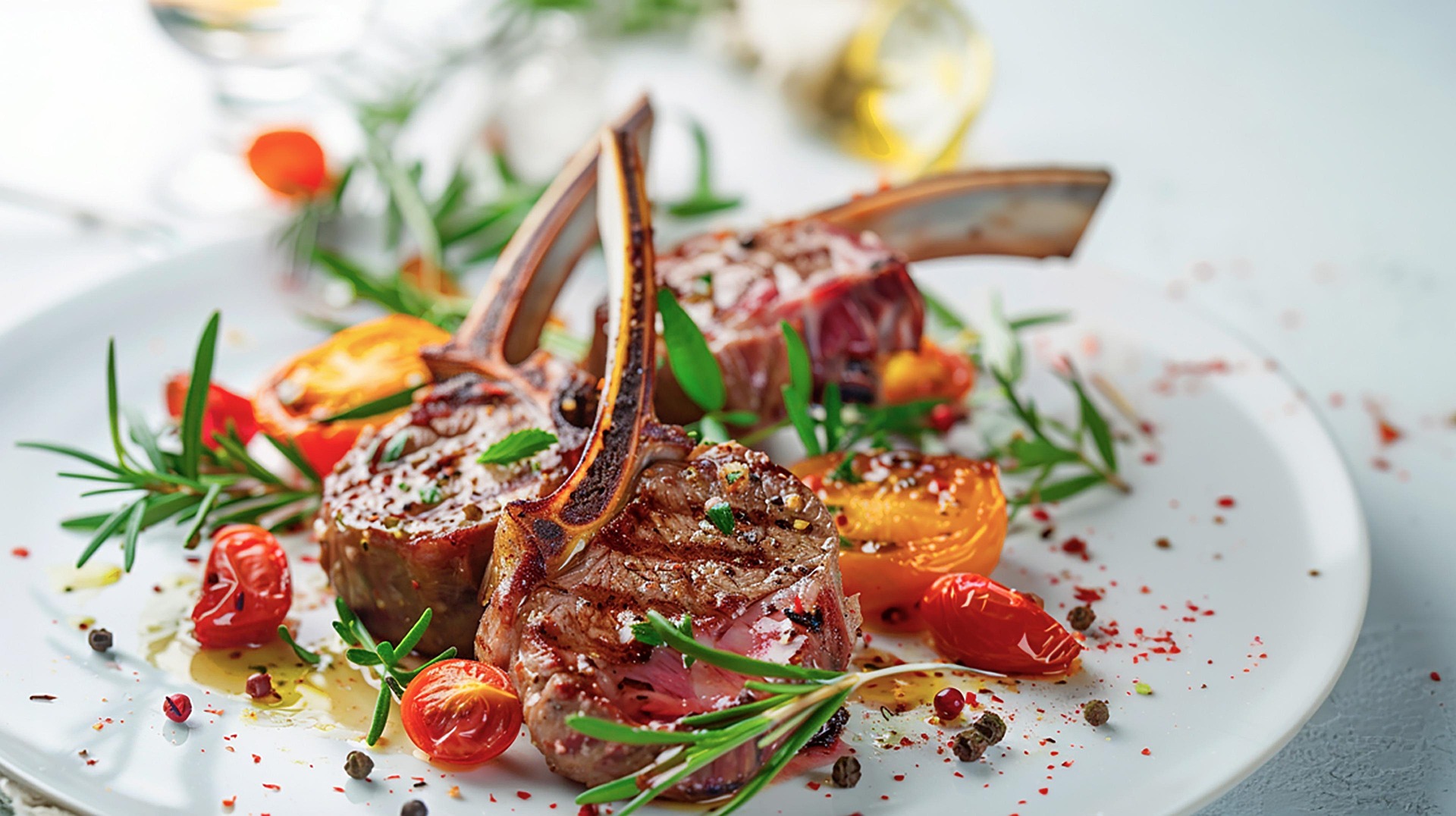
Herb-Scattered Lamb Chops with Roasted Tomatoes
Three frenched lamb chops arranged in french plating style upright on a wide white plate, surrounded by roasted cherry and heirloom tomatoes, fresh rosemary sprigs, micro herbs, and a scattered finish of cracked pepper and chili flakes with an olive oil drizzle.
Step-by-Step
1. Choose your canvas.
Use a large, wide, flat white plate — at least 11–12 inches. The negative space (bare white rim) is intentional and essential. Do not crowd the plate edge.
2. Anchor the base.
Place a small mound of your accompaniment (roasted onion, purée, or simply a halved golden/orange heirloom tomato) slightly left of center. This is the structural base the chops will lean against.
3. Position the lamb chops.
Stand three frenched chops upright, bones pointing skyward and fanning slightly outward — like a loose tripod. Lean them inward against each other and against the base anchor so they hold without falling. The bones should angle in three different directions for visual drama.
4. Place the roasted tomatoes.
Tuck roasted cherry tomatoes (blistered, slightly collapsed) and halved heirloom tomatoes around the base of the chops — not in a circle, but casually clustered in two or three groupings. Vary colors: deep red cherry tomatoes on one side, golden/orange heirlooms on the other.
5. Add the rosemary.
Lay two or three fresh rosemary sprigs organically around the chops — one tucked beneath the meat, one extending toward the plate rim, one pointing a different direction. They should look naturally scattered, not symmetrical.
6. Scatter the micro herbs.
Pinch small clusters of micro greens or fresh thyme/tarragon tips and drop them over and between the chops. Let a few land on top of the meat itself.
7. Season visually.
Pinch and scatter flaky sea salt and cracked mixed peppercorns (green and black) across the plate surface, not just on the meat — let them fall on the white plate rim area too. Do the same with a light dusting of red chili flakes or Aleppo pepper for the red speckle effect visible in the photo.
8. Finish with olive oil.
Using a spoon, drizzle a thin stream of good olive oil in a loose, irregular arc around the base of the chops. Don’t overdo it — you want glistening pools, not puddles.
9. Final check — the bones.
Wipe the frenched bones with a clean damp cloth if they have any char smudges you don’t want. The exposed bone should look clean and architectural against the rusticity of the plate.
Key Design Principles at Work
• Height — the upright bones create vertical drama on an otherwise flat plate
• Controlled chaos — the herbs and spices look scattered but are deliberately placed in french plating
• Color blocking — red tomatoes left, golden tomatoes right, green herbs threading through
• Negative space — the wide white rim is left completely bare to frame the composition.
French Plating Instructions
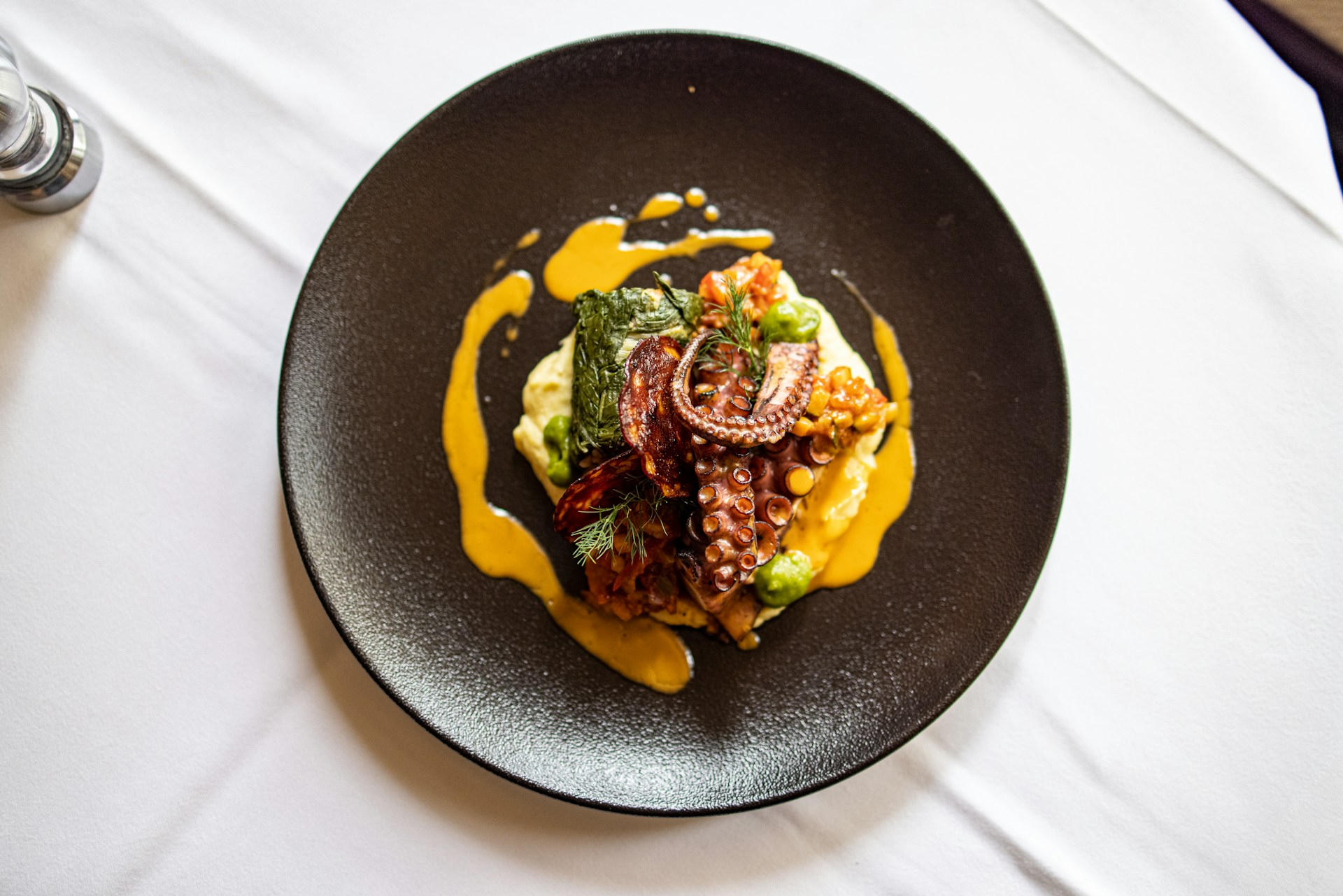
Grilled Octopus with Saffron Emulsion
What’s on french plating: Charred octopus tentacles over a whipped white bean or skordalia purée, with braised greens, edamame or fava beans, pickled or roasted cherry tomatoes, fresh dill, and a saffron (or romesco-style) sauce draped across the bowl.
Step 1 — Choose Your Vessel
Use a wide, shallow matte black bowl (approximately 10–11″). The dark surface is essential — it creates contrast against the golden sauce and bright greens.
Step 2 — Lay the Purée Base
Spoon a generous, uneven mound of whipped purée slightly off-center toward the bottom third of the bowl. Use the back of a spoon to create a rustic, textured surface — do not smooth it flat. The roughness gives the dish an organic, unfussy quality.
Step 3 — Add the Braised Greens
Tuck a folded portion of dark braised greens (spinach, chard, or similar) against the upper-left edge of the purée, slightly elevated. This creates height and a dark anchor point.
Step 4 — Place the Octopus
Arrange 2–3 tentacle sections across the center of the purée, overlapping slightly and curling naturally. Allow the sucker side to face upward on at least one piece — this is the visual centerpiece. The charred, mahogany color should dominate the middle of the plate.
Step 5 — Scatter the Accompaniments
Distribute the small elements loosely around and slightly beneath the octopus:
• Edamame or fava beans — drop organically around the perimeter of the mound
• Roasted cherry tomatoes or lentils — cluster near the upper-right, adding warmth and texture contrast
Step 6 — Sauce Last
Using a squeeze bottle or a spoon, drag the saffron emulsion in an irregular arc starting from the upper portion of the bowl sweeping toward the lower right. It should pool slightly in two or three spots — not be uniformly distributed. Think gesture, not symmetry.
Step 7 — Garnish
Finish with a few fresh dill fronds tucked naturally into the top of the octopus cluster. Do not place them flat — let them stand slightly upright for height.
Key Design Principles at Work:
• Off-center composition — nothing sits in the middle of the bowl
• Varied heights — greens elevate the back, octopus crowns the center
• Controlled chaos — the sauce and scattered elements feel effortless, not arranged
• Color story — deep charred brown + golden yellow + green + white creates full-spectrum visual interest against the black bowl
French Plating Instructions
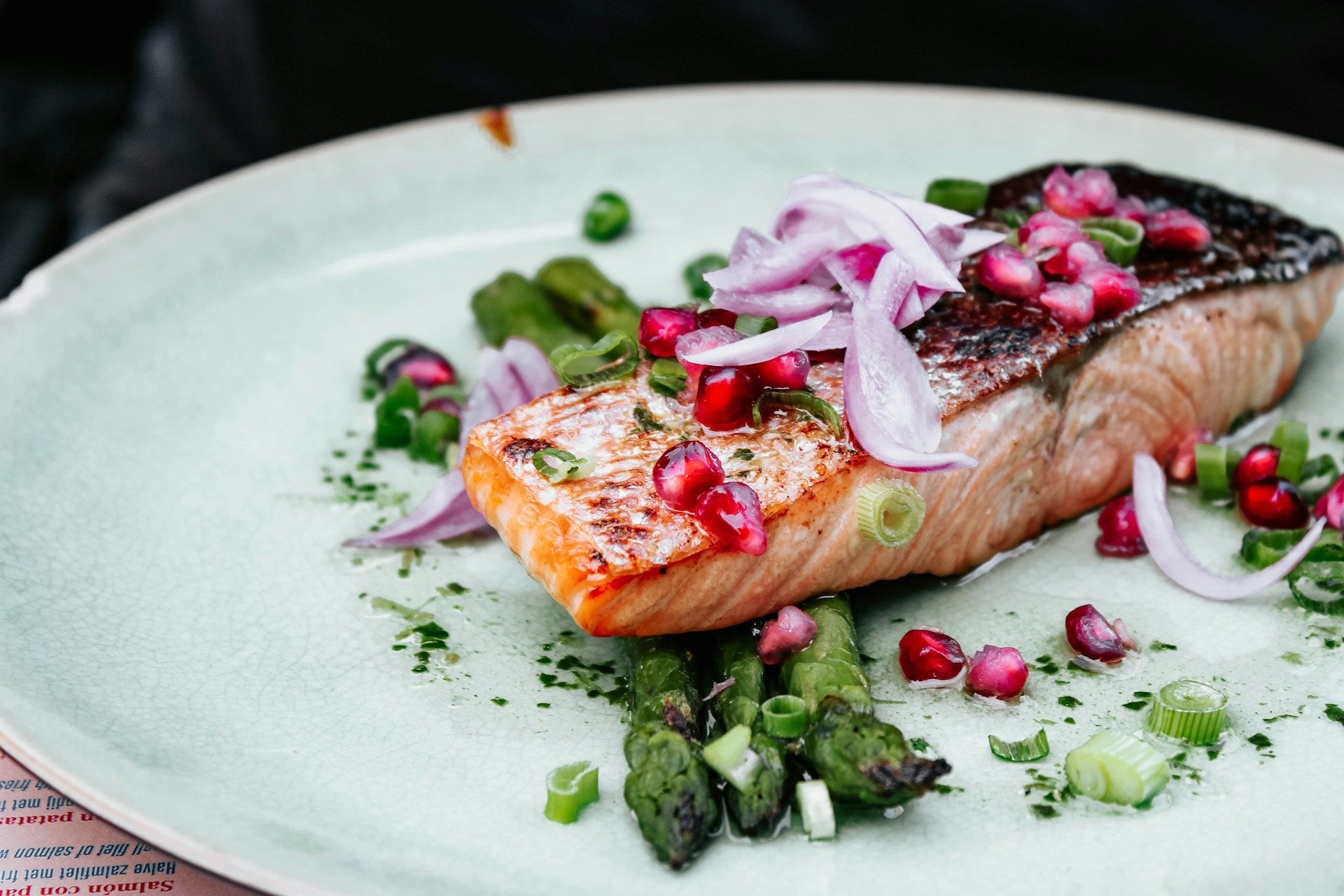
pan-seared salmon over grilled asparagus with a pomegranate-onion garnish
Here’s a Step-by-Step French Plating Guide Recreating Pan-seared Salmon over Grilled Asparagus with a Pomegranate-Onion Garnish.
Step 1 of 6
Warm and wipe the plate
Use a wide, shallow bowl-plate with a pale celadon or matte white finish. Run it under warm water or place it in a low oven (60°C) for 2 minutes, then dry thoroughly. A warm plate keeps food at serving temperature and prevents condensation beading.
Chef’s note: The soft off-white of this plate makes every color — the orange salmon, dark green asparagus, ruby pomegranate — pop vividly.
Step 2 of 6
Build the asparagus bed
Lay 5–7 grilled asparagus spears diagonally across the center third of the plate, all pointing in the same direction (roughly 10 o’clock to 4 o’clock). Keep the tips slightly fanned at one end. The asparagus acts as the structural base that lifts the salmon off the flat plate.
Chef’s note: Trim asparagus to roughly equal lengths before grilling so the bed sits level under the fish.
Step 3 of 6
Set the salmon
Place the salmon fillet skin-side down, centered squarely over the asparagus bed. The fish should rest slightly elevated on the spears rather than flat on the plate. Orient it the same diagonal as the asparagus so the composition reads as one unified element.
Chef’s note: Let the salmon rest 2 minutes off heat before plating — it firms slightly and holds its shape better when lifted onto the plate.
Step 4 of 6
Add the pomegranate and onion garnish
Scatter pomegranate arils generously across the top face of the salmon. Then lay a small cluster of thinly-sliced red onion (pickled or raw) loosely over the arils near the center, letting the petals fall naturally rather than placing them precisely.
Chef’s note: The photo uses lightly pickled red onion — soak raw slices in red wine vinegar with a pinch of sugar for 10 minutes to mellow sharpness and deepen the purple color.
Step 5 of 6
Scatter garnish on the plate rim
Take a small amount of the same garnish elements — a few pomegranate arils, a couple of onion petals, and a pinch of sliced spring onion — and scatter them loosely around the plate rim on both sides of the salmon. This ‘escape’ of garnish off the main protein is what gives the dish its editorial, composed-but-relaxed feel.
Chef’s note: Less is more here. The scattered elements should feel like they fell naturally, not like they were placed. Use only 4–6 arils and 2–3 onion shreds per side.
Step 6 of 6
Finish and serve
Give the asparagus and plate a light drizzle of high-quality olive oil (or the pan drippings). Add a final pinch of finely chopped fresh herbs — parsley or chives — dusted lightly across the plate surface for the faint green fleck effect visible in the photo. Serve immediately.
Chef’s note: The barely-visible green herb dust in the photo is achieved by pressing chopped herbs through a fine sieve, or simply mincing very finely and sprinkling from height to get an even fall.
THE PHILOSOPHY BEHIND THE PLATE
You have now learned three plates in french plating. But what I truly want you to understand is the WHY behind all of it. French plating is not decoration. It is communication. Every element on that plate tells your guest: I thought about you. I considered your experience. I wanted this moment to be beautiful for you.
The odd numbers — three dots, five slices, one perfect herb — they are not accidents. The human eye finds odd numbers naturally dynamic, always searching for balance it never quite achieves, which keeps the eye moving across the plate, discovering things. Even numbers feel static. Finished. Odd numbers feel alive. French Plating.
The empty space is not laziness. In Japan they call it ‘ma’ — the meaningful void. In France we simply call it elegance. A crowded plate is an anxious plate. A plate with breath is a confident one.
And the height — always a little height somewhere, a stack, a standing herb, a proudly unmolded fondant — because height creates shadow, and shadow creates drama, and drama is what you remember at midnight when you are still thinking about that meal.
Now go, my friend. Set your table. Warm your plates. Pick up that spoon with confidence. And remember — in the kitchen, as in life, the greatest ingredient of all is love expressed through attention.
Bon appétit — et bonne chance!
— Chef Francis



I’ve tried this but mine don’t turn out as nice as yours but I’l try again
I never have thought of this but since I’m in a new relationship this might be worth a try for a date night. I’m not so sure about trying that octupus dish though. Personally I think their adorable so I just couldn’t image eating them much less killing them. It’s so strange wha t we eat as a human race. what if we were hunted for our meat? That’s a heavy thougth.