

Eating Like a God While a Kingdom Starved — Obscene Dining Rituals of Louis XIV
The year 1709 was one of the most catastrophic in French history. A brutal winter — the worst Europe had experienced in centuries — killed crops, froze rivers solid, and sent temperatures so far below zero that fruit froze on the trees before it could be harvested. Wine froze in bottles. Livestock died in fields. Bread became so scarce that peasants across France were reduced to eating grass, bark, and whatever could be scraped from frozen ground. Tens of thousands died of cold and starvation. Children begged in the streets of Paris while their parents buried siblings and neighbors in soil too hard to properly dig.
At Versailles, the Sun King was deciding what to have for breakfast.
The contrast between daily obscene dining rituals of Louis XIV and the suffering of his people in 1709 is not merely a historical footnote — it is one of the starkest illustrations of absolute power ever recorded. What happened during the obscene dining rituals of King Louis XIV each day was not simply eating. It was ceremony, theater, and the most extravagant demonstration of divine right imaginable, conducted with elaborate ritual while the kingdom that funded it slowly starved outside the palace gates.
The Morning Begins — Breakfast in Bed and the Rising of the Sun King
Louis XIV’s day began not with a quiet moment of personal privacy but with a performance. The ritual of the lever — the King’s rising — was a carefully choreographed ceremony attended by members of the court who considered the invitation to witness the King’s morning routine a mark of significant privilege and favor. To be present at the lever was to be close to power. To be excluded was a social wound.
Before Louis rose from his bed, he was attended to with food. Meals were delivered to the royal chambers — there began the obscene dining rituals of Louis XIV before the formal business of dressing had even commenced. Contemporary accounts and historical records of the period document a breakfast of extraordinary scale by any human standard. Louis is recorded as having consumed quantities of food at his morning meal that would have fed an entire peasant family for days.
Among the most striking documented accounts of the obscene dining rituals of Louis XIV was his consumption of whole chickens — multiple birds — along with substantial quantities of champagne, wine, and other accompaniments. Whether the precise numbers align exactly with popular memory, the broader documented reality is not in dispute: Louis XIV ate at breakfast what most of his subjects could not eat in a week, and he did so with the complete and uncomplicated assurance of a man who had never once questioned whether he deserved it.
The Dressing Ritual — Even This Was a Meal
After breakfast, the business of dressing the King commenced — another ceremony of extraordinary elaboration involving specific courtiers assigned to specific tasks. The man permitted to hand Louis his shirt was of higher rank than the man permitted to hand him his breeches. The hierarchy of dressing was as codified and serious as any military protocol.
Throughout this process, the obscene dining rituals of Louis XIV during consumption of food and drink continued in various forms. The palace kitchens operated essentially without pause, the brigade of cooks and servants maintaining a constant state of readiness to produce whatever the King or any member of the court required at any moment. The organizational challenge alone was staggering — Versailles at its height housed somewhere between three and ten thousand people depending on the occasion, and the kitchen infrastructure required to feed that population while simultaneously maintaining the King’s extraordinary personal standard was unlike anything else in the world.
The Grand Couvert — Dining as Public Theater
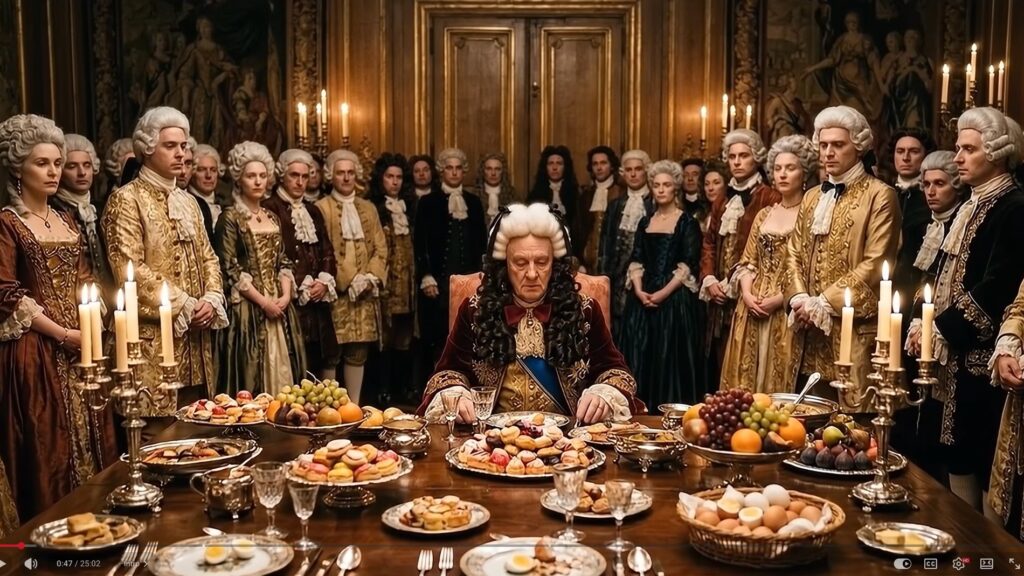
Louis XIV’s formal meals — particularly his public dinners, known as the grand couvert — were open to observation by members of the public and court alike. Spectators would gather to watch the King eat, standing in respectful silence while he worked through a succession of courses that by modern standards would be almost incomprehensible in their scale and richness.
A typical royal dinner might include multiple meat courses — beef, game, poultry — alongside elaborate preparations of vegetables, pastries, and confections. Sauces were complex and rich. Presentation was theatrical. The silver service alone represented a fortune. And throughout, the King ate with focused enthusiasm. Historical accounts consistently describe Louis as a genuinely passionate and prodigious eater who took obvious pleasure in his food — a man, in the words of observers, who ate with an appetite that impressed even those accustomed to royal excess.
His personal physician recorded with clinical precision what Louis consumed at individual meals, partly out of professional concern and partly because the quantities were simply remarkable enough to document. The records paint a picture of a man whose relationship with food was one of the few areas of his life entirely free of political calculation — he ate enormously because he wanted to, because he could, and because in his worldview the abundance of his table was simply the natural expression of his position in the divine order of things.
Outside the Gates — A Different Reality
The winter of 1709 made the contrast between Versailles and the rest of France impossible to ignore even for those normally insulated from it. Fruit froze on trees throughout the countryside. Seed grain — the supply essential for the following year’s planting — was destroyed by cold, meaning that the disaster of 1709 would extend its consequences well into 1710 and beyond. The Seine froze. The Mediterranean coast experienced snowfall it had not seen in living memory. Wolves, driven from frozen forests by hunger, entered villages.
Louis XIV, to his limited credit, did eventually melt down some of the royal silver to fund relief efforts. He also reportedly encouraged the court to reduce its consumption temporarily. These gestures, measured against the scale of the suffering and the uninterrupted luxury of Versailles, registered as precisely what they were — insufficient and largely symbolic.
What the Table Reveals About the Man
The Kings court did not create the obscene dining rituals of Louis XIV out of cruelty. They created them out of an entirely sincere belief that his position required and justified them — that the magnificence of the royal table was as essential to the proper functioning of France as its armies or its laws. The theater of his meals was inseparable from his theory of kingship.
But history has a way of placing things side by side that power prefers to keep separate. The image of Louis XIV consuming whole chickens and champagne in his bedchamber while the fruit froze on the trees of his starving kingdom is not just a portrait of one man’s excess. It is a precise and unforgettable picture of what absolute power looks like when it has completely lost the ability to see itself clearly — fed, comfortable, and utterly convinced that the suffering outside the window has nothing whatsoever to do with the feast inside.


